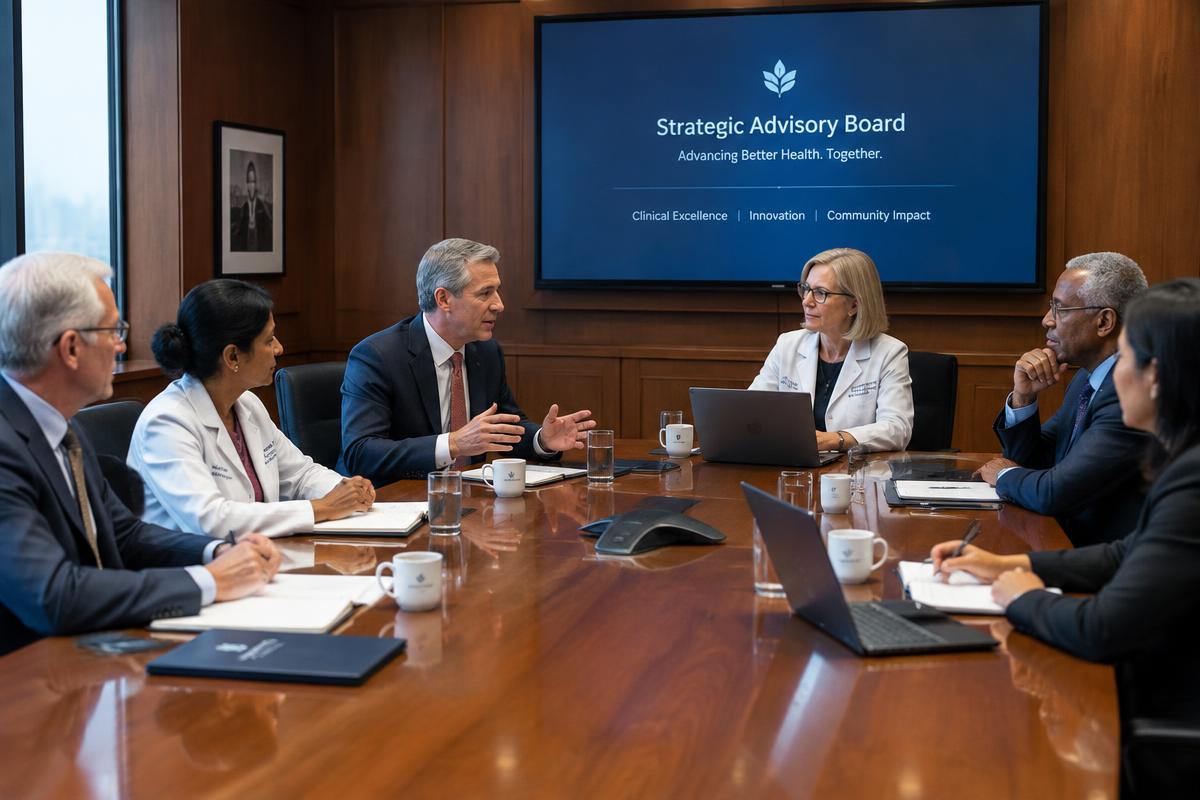
Standing counsel, quarterly cadence
Advisory Boards for healthcare and life sciences
Standing advisory boards of KOLs and industry operators who meet on a regular cadence to guide strategy, clinical development and commercialisation.
HealthcareMarketResearch delivers advisory boards for pharmaceutical, biotech, medical device, diagnostics and digital health companies, as well as consultancies and investors.
Projects run from our India headquarters with a global network of 5,000+ market researchers, so you get senior attention, round-the-clock delivery and local fieldwork in every major market.
What you receive
- Board design and recruitment
- Contracting and fair-market-value compliance
- Quarterly sessions
- Minutes and action tracking
Common use cases
- Clinical development advisory
- Commercial strategy boards
- Digital health product councils
- Regional market boards
At a glance
Advisory Boards: the short version
Turnaround, typical scope, audiences, coverage and deliverables for advisory boards — the answer-first version, before you write a brief.
- Turnaround
- Board designed and recruited over weeks, then sessions on a quarterly cadence
- Typical scope
- 6–12 standing members, meeting quarterly or twice a year
- Who we reach
- KOLs, hospital leaders, payer advisors and former industry operators
- Coverage and languages
- In person across Mumbai, Delhi NCR, Bengaluru, Hyderabad, Pune and 20+ Indian cities; English, Hindi and major regional languages
- What you receive
- Board charter and member profiles, compliant contracting, session decks, minutes and actions
- How it runs
- In person in India, with virtual interim sessions between meetings
This is an in-person service, delivered in India only. Scopes are typical, not fixed packages — every project is sized to your brief. Studies follow EphMRA, BHBIA and Insights Association guidance, with GDPR, HIPAA and DPDP-aligned handling of participant data.
How a project runs
Five steps from mandate to handover
Every advisory boards project follows the same path, with a named HMR lead accountable at each step.
- 01
Charter and objectives
What the board is for, what it will be asked to review or decide, how often it meets, and what counts as a successful year for it.
Written charter
- 02
Member design and recruitment
A composition balanced across specialty, geography, institution type and seniority, so no single perspective dominates the room. Recruited and conflict-checked individually.
Balanced by design
- 03
Contracting and compliance
Fair-market-value honoraria, written scope of work, transparency obligations and UCPMP-aligned terms, documented before anyone is engaged.
Fair market value
- 04
Run the sessions
Pre-reads out in advance, a facilitated agenda that leaves room for disagreement, and live synthesis so the room leaves with the same understanding.
Facilitated, not presented
- 05
Minutes, actions and refresh
Minutes and an action tracker after every session, carried into the next one, with membership refreshed as the strategy and the therapy area move.
Tracked between meetings
Who we reach
Stakeholders we recruit for advisory boards
Recruited and visited in person by our own India teams, across metro and tier-2 markets.
Clinical advisors
- Therapy area chairs and unit heads
- High-volume practising specialists
- Guideline and protocol authors
- Tier-2 city clinical leaders
- Nursing and allied health leads
Payer and access advisors
- Insurance medical directors
- Scheme and policy advisors
- Health economics leads
- Pricing and reimbursement specialists
- Formulary committee members
Hospital and institution leaders
- Medical superintendents
- Hospital group clinical directors
- Pharmacy and therapeutics chairs
- Procurement and biomedical heads
- Diagnostic network leaders
Industry operators
- Former country and regional heads
- Medical affairs leaders
- Regulatory affairs veterans
- Market access and commercial leads
- Supply chain and manufacturing heads
Patient voice
- Patient advocacy group leaders
- Caregiver representatives
- Rare disease community founders
- Adherence programme leads
- Patient educators
Independent chairs
- Experienced board facilitators
- Academic chairs
- Health economists
- Ethics and compliance advisors
- Non-executive directors
Method comparison
Advisory Boards compared with the alternatives
The same question can be answered several ways. This is how advisory boards differs from the methods clients usually weigh it against — Advisory Boards is the highlighted column.
| Advisory Boards | Multi-Expert Panels | Workshops and Round Tables | Long-term Consulting Support | |
|---|---|---|---|---|
| Speed | Designed once, then quarterly | Panel assembled to the brief | Convened to a fixed date | Consultant matched in 5–10 business days |
| Typical sample | 6–12 standing members | 3–6 specialists in one session | 8–25 invited participants | 1–3 embedded consultants |
| Depth of insight | Cumulative and relationship-based | Debate, consensus and dissent | Facilitated group reasoning | Full context, months of work |
| Best for | Standing counsel across several quarters | A contested question settled in one room | Alignment between people who have to agree | Capability inside the team for months |
| Typical output | Session decks, minutes, action tracker | Consensus and dissent map, transcript | Live synthesis, recommendations deck | Working deliverables, knowledge transfer |
| Runs in person in India |
Compliance
How we keep advisory boards compliant
Healthcare research carries obligations that general market research does not. These apply to every project, in every market.
Industry codes
EphMRA, BHBIA, Insights Association and ESOMAR guidance on how healthcare research is conducted.
Adverse events
Trained adverse event reporting on every healthcare interview, routed to your pharmacovigilance contact.
Data protection
GDPR, HIPAA and India's DPDP Act. Consent is captured before any recording or transcription.
Fair market value
Honoraria benchmarked to fair market value, with UCPMP-aligned contracting and a documented scope of work.
Is this the right fit?
When to use advisory boards — and when not to
We would rather point you at the right approach than sell you this one. Here is where advisory boards earns its place, and where something else does the job better.
Choose this when
- The same group of advisors needs to see a strategy develop over quarters, not once
- Clinical development and commercial decisions keep needing the same expert context
- Relationships with the people who shape practice are part of the objective
- Compliant, documented engagement of KOLs is a requirement, not an afterthought
Consider something else when
- You need one answer to one question this month
- A single contested debate would settle it better than standing counsel
- You need projectable data across a specialty
- You need someone to do the work rather than advise on it
Alternatives
Where another method fits better
Each of these answers a different kind of question. Tell us the decision and we will recommend the right one, even when it is not this service.
Advisory Boards across India
By industry
FAQs
What is advisory boards in healthcare market research?+
Advisory Boards is one of the ways HealthcareMarketResearch connects pharma, biotech, medtech and healthcare clients with verified physicians, payers and industry experts to answer strategic questions. Standing advisory boards of KOLs and industry operators who meet on a regular cadence to guide strategy, clinical development and commercialisation.
How quickly can advisory boards start?+
Most projects start within 24–48 hours of a confirmed brief, drawing on our 5,000+ network. Board designed and recruited over weeks, then sessions on a quarterly cadence.
Where do you offer advisory boards?+
In India, where our in-person field teams are based — across Mumbai, Delhi NCR, Bengaluru, Hyderabad, Pune and 20+ Indian cities.
What is a typical advisory boards scope?+
6–12 standing members, meeting quarterly or twice a year. You receive: Board design and recruitment, Contracting and fair-market-value compliance, Quarterly sessions, Minutes and action tracking. Everything is sized to the brief rather than sold as a fixed package.
Who can you reach for advisory boards?+
Clinical advisors, Payer and access advisors, Hospital and institution leaders, Industry operators, Patient voice, Independent chairs. Each group is screened on specialty, setting and experience before anyone joins a study.
What is the difference between advisory boards and multi-expert panels?+
Advisory Boards is best for standing counsel across several quarters, with 6–12 standing members and cumulative and relationship-based. Multi-Expert Panels is best for a contested question settled in one room. If both apply, the two are often run in sequence.
Other services
Have a healthcare question that needs real answers?
Brief us today and talk to a verified expert this week.